← Back to all projects

Personal

KYBER — The Lightsaber Atelier

A cinematic 3D lightsaber configurator that turns every build into a shareable link.

Role
Solo developer and designer
Timeframe
Sep 2026 — Present
Status
Active
Team Size
1
Domain
Interactive 3D web experience / product configurator
Live site
KYBER — The Lightsaber Atelier cover

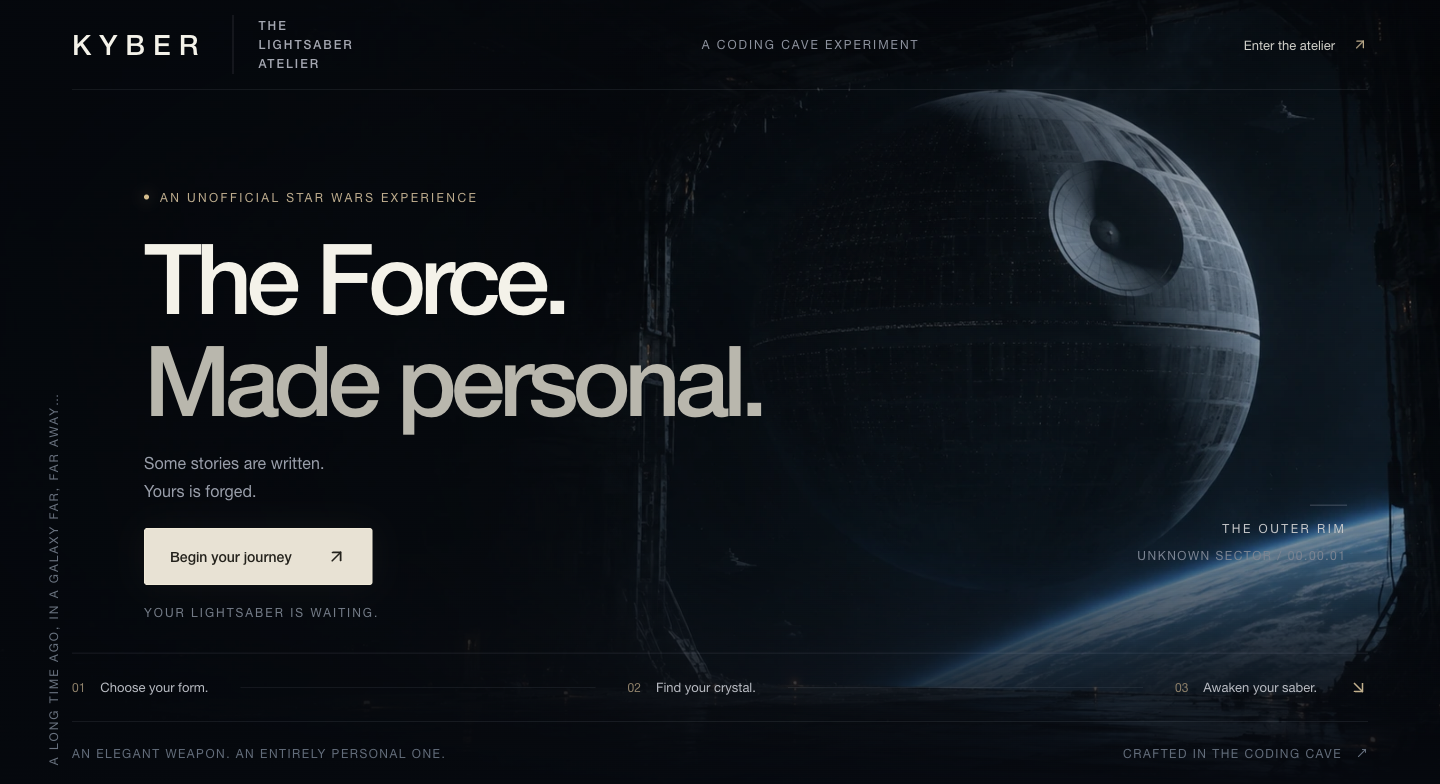
KYBER is a cinematic web experience that lets anyone design their own lightsaber and share it. It opens on a film-style shot of the Death Star seen from an abandoned hangar, then moves into an "atelier" where you choose a hilt, a finish, and a crystal, watch the saber turn in real time, and finally ignite the blade in a full-screen moment with its own sound. I designed and built the whole thing solo, from the 3D work and the visual design to the deployment.

Everything you see is generated in the browser. The saber is not a downloaded 3D model but geometry built in code, lit by a studio environment that ships inside the app, and the ignition sound is synthesized on the fly rather than played from an audio file. There are no accounts and no database anywhere in the product: your entire build is encoded into the web address, so sending someone the link is enough for them to open your exact saber. You can also name a build and download it as a poster-style image card captured from the live 3D view.

The experience is designed to work for everyone. It is fully keyboard-operable, respects the system setting for reduced motion, and reshapes itself on phones with large touch targets and a dedicated mode for spinning the saber with a finger. The site is prerendered to static files and served from a hardened container behind Nginx, which keeps it fast and inexpensive to run. It is an unofficial fan project, not affiliated with Lucasfilm or Disney.

Solo developer and designer

  • Designed and built the entire product end to end, from the cinematic landing page through the configurator, ignition sequence, and export flow
  • Modeled and shaded the modular lightsaber procedurally in Three.js and React Three Fiber, with no external 3D model assets
  • Built a locally generated studio lighting environment using Lightformer area lights, contact shadows, and physically based materials
  • Implemented URL-as-state configuration with catalog validation, so all 1,215 preset combinations plus custom hex crystals round-trip through a shareable link
  • Synthesized the ignition, hum, and extinguish audio at runtime with the Web Audio API instead of shipping audio files
  • Built the PNG build-card exporter that composites the live WebGL frame onto a 2D canvas with typeset build details
  • Owned accessibility: keyboard-operable tabs, radio groups and dialogs, focus trapping, reduced-motion support, and 44px touch targets
  • Built the responsive mobile layout, including native document scrolling, an opt-in Explore gesture mode, and safe-area-aware bottom sheets
  • Authored the multi-stage Docker image and hardened Nginx config, and deployed the site to a custom domain via Dokploy
  • Wrote the configuration test suite covering every option combination, malformed URL input, and filename normalization
  • Cinematic Death Star landing sequence with pointer parallax, staggered reveals, and a View Transitions handoff into the builder
  • Real-time 3D configurator with orbit, zoom, and an exploded assembly view
  • 1,215 preset combinations across hilt, emitter, grip, finish, accent, and crystal
  • Custom crystal color wheel with touch input, keyboard-accessible sliders, and hex entry
  • Full-screen cinematic ignition with animated blade, color spill, and synthesized audio
  • Original ignition, hum, and extinguish sound synthesized at runtime with the Web Audio API
  • Shareable links that encode and revalidate every choice, with no account or database
  • Downloadable 1080x1350 PNG build card composited from the live WebGL frame
  • Crystal chamber reveal and a one-time floating assembly animation on entry
  • Full keyboard operation, focus management, reduced-motion support, and WebGL failure fallback
  • Mobile layout with native scrolling, pinned preview, opt-in Explore gesture mode, and safe-area-aware bottom sheets

Problem

Making a lightsaber look like a premium physical object in a browser without shipping heavyweight 3D model, texture, or HDRI assets.

Solution

Built the hilt from modular procedural geometry with physically based materials, and generated the studio environment locally from Lightformer area lights plus contact shadows, so the entire look compiles into the bundle.

Problem

Letting users share an exact build without a backend, accounts, or storage.

Solution

Made the URL the single source of truth: configuration is serialized to versioned query parameters and validated on read against option catalogs, with unknown values falling back to defaults and names control-stripped and length-bounded.

Problem

On touch devices, OrbitControls captured every gesture, so users could not scroll past the 3D preview.

Solution

Disabled orbit controls by default on mobile and set the canvas to pan-y so swipes scroll the page, then added an explicit Explore toggle that hands control to the saber and a Done action that returns to normal scrolling.

Problem

Exporting a build card required reading pixels back from a WebGL canvas, which is normally cleared after each frame.

Solution

Enabled preserveDrawingBuffer on the renderer, then scaled the live canvas into a 1080x1350 2D canvas composition with typeset build details and exported it via toBlob and an object URL.

Problem

The mobile save dialog rendered half off the left edge of the screen despite bottom-sheet styles that reset transform.

Solution

Traced it to Tailwind CSS 4 centering the dialog with the CSS translate property rather than transform, so the reset never applied; reset translate as well and anchored the sheet with explicit left and right edges plus safe-area padding.

Problem

Delivering saber audio without shipping sound files or violating browser autoplay policies.

Solution

Synthesized ignition and extinction as filtered oscillator frequency sweeps and the hum as layered detuned oscillators, creating the AudioContext only on explicit user interaction and suspending it on visibility change.

Problem

Keeping a heavy WebGL scene from blocking first paint or breaking on unsupported hardware.

Solution

Prerendered the routes to static HTML, lazy-loaded the 3D module behind Suspense and an error boundary with an explicit WebGL failure message, preloaded it on idle, hover, and focus, and capped the device pixel ratio lower on mobile.
Languages

TypeScriptCSSHTML

Frameworks

React 19TanStack StartTanStack RouterReact Three FiberTailwind CSS 4shadcn/uiBase UI

Tools

Vite 8Node.js 22Three.js@react-three/dreiDockerNginxDokployoxlintoxfmtnode:testTypeScript compiler

Infrastructure

Deployment
Dokploy, Nginx (static), OpenAI Sites (static hosting config)
Containers
Docker
Other
Multi-stage Docker build: Node 22 Bookworm slim builder to unprivileged Nginx Alpine runtime on port 8080, Container HEALTHCHECK against an Nginx /healthz endpoint, Immutable one-year caching for content-hashed assets, no-cache revalidation for HTML, Static prerendering of the landing and /build routes into dist/client, No environment variables, secrets, or persistent volumes required

The shipped product contains no runtime AI: there are no model calls, API keys, or inference at request time. AI was used in the build process instead. The cinematic Death Star hangar background was produced with a generative image tool from a detailed art-direction prompt preserved in docs/artwork.md, then converted to WebP for delivery. The application code was also largely AI-assisted, written with an AI coding agent under human direction and review.

Use Cases

Generative image art for the landing page backgroundAI-assisted code authoring and refactoring under human direction

Providers

OpenAI

Deployed and publicly available at kyber.montgomerylabs.tech, served as a prerendered static site from a containerized Nginx runtime that requires no database, environment variables, or persistent storage. Automated tests confirm all 1,215 configuration combinations survive a share-link round trip.

  • Designed and shipped a cinematic 3D lightsaber configurator solo, from procedural Three.js modeling and studio lighting through visual design, accessibility, containerization, and production deployment
  • Eliminated all backend infrastructure by encoding application state in validated URL parameters, delivering 1,215 shareable build combinations plus custom colors with no database, accounts, or API keys
  • Modeled and shaded the saber entirely from procedural geometry and a locally generated Lightformer environment, removing every external 3D model, texture, and HDRI dependency from the bundle
  • Synthesized all ignition and hum audio at runtime with the Web Audio API, shipping zero audio assets while honoring browser autoplay policies and suspending on tab hide
  • Built a client-side export pipeline that composites the live WebGL frame onto a 2D canvas to produce a 1080x1350 branded PNG build card with typeset details and filesystem-safe filenames
  • Engineered accessibility throughout: keyboard-operable tabs, radio groups, and dialogs, focus trapping and restoration, reduced-motion paths for every animation, and 44px touch targets
  • Rebuilt the mobile experience around native document scrolling with an opt-in Explore gesture mode, resolving the conflict between page scrolling and 3D orbit controls on touch devices
  • Diagnosed and fixed a mobile dialog rendering half off-screen, tracing it to Tailwind v4 centering via the CSS translate property while the override reset only transform
  • Cut the production image to a static Nginx runtime with a multi-stage Docker build, adding a health check, immutable hashed-asset caching, and an unprivileged non-root container
  • Wrote a test suite that exhaustively verifies all 1,215 configuration combinations round-trip through share links, plus malformed URL input and filename normalization

Have a project in mind?

Let’s talk about what you’re building and how Montgomery Labs can help ship it.

Start a project